23–24 January 2027 · Veliky Novgorod
ЗИМНИЕ ВЫХОДНЫЕ ВЕЛОКРОССА · 3ВВ
Два дня ТИПАЦИКЛОКРОССА: Cyclocross, Gravel, Fixed gear, МТБ и беговой кросс. Один день или оба.
23–24 January 2027 · Veliky Novgorod
Два дня ТИПАЦИКЛОКРОССА: Cyclocross, Gravel, Fixed gear, МТБ и беговой кросс. Один день или оба.
19 June 2027 · Batetsky
Tsar Grader 202725 October — 7 November 2026 · XCnews
INOCROSSApril 10-11, 2027 · Veliky Novgorod
Spring Cyclocross WeekendFrom 22 November 2026 · Saint Petersburg and the Leningrad Region
WINTER CUP XCNEWS499 ₽ / month · Для гонщиков
FATRACING PREMIUMОт 2 999 ₽ / month · For business
FATRACING PROCadence is the number of full pedal revolutions per minute, usually in rpm. It is not the speed of the bicycle or the power: at the same cadence, different gears give different speeds. To choose a gear, it is useful to look at the cadence along with the surface, slope, and your load.
The cadence sensor counts the rotation of the cranks and transmits data to the computer or app. A separate power meter or trainer can also provide cadence, but the measurement method and availability depend on the model.
For a simple assessment, count the full rotations of the same pedal in 30 seconds and multiply by two. For example, 40 rotations in 30 seconds is 80 rpm. Counting is convenient to do on a steadily secured trainer; do not be distracted by the screen and counting while moving in traffic.
Zero in the record may mean free rolling, loss of connection, or lack of data. First, check the source; the connection is explained in computer setup.
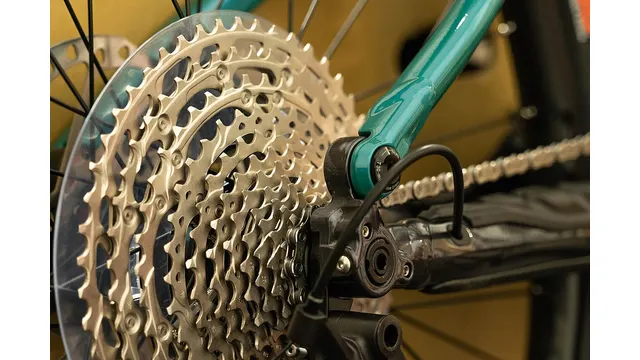
With a conventional chain drive, the gear ratio is equal to the number of teeth on the front sprocket divided by the number of teeth on the rear. Development is the distance covered in one pedal revolution: the wheel circumference in meters multiplied by this ratio.
Speed, km/h = development, m × cadence, rpm × 60 / 1000. Back calculation: cadence = speed × 1000 / 60 / development. The formulas assume rolling without slipping and pedaling with power transmitted to the wheel.
Use the measured circumference or estimated reference. The website has single gear calculator and 1× and 2× transmission table.
Let's set the training wheel circumference to 2180 mm, that is, 2.18 m. On the 40/20 gear ratio, it equals 2, and the development is 4.36 m. At 80 rpm, the speed will be 20.93 km/h, at 90 rpm — 23.54 km/h.
On the same wheel with a 40/25 gear, the development will be 3.488 meters. At 80 rpm, the speed is 16.74 km/h. To move at 25 km/h, you will need approximately 95.6 rpm at 40/20 and 119.5 rpm at 40/25.
This is verifiable arithmetic, not a proposal to go with a cadence of 119.5. The values are checked against the current mathematics of FATRACING calculators. A circumference of 2180 mm is not standard for all wheels.
When speed decreases on an incline, a lighter gear allows you to continue pedaling at a higher cadence at the same speed. It doesn't eliminate the work against the incline but changes the relationship between pedaling and wheel movement.
If you regularly have to force a too heavy gear, compare the lower gears in climbing guide. Check the top gear too: reducing the front sprocket shifts the entire range.
Before buying parts, separately confirm compatibility. The calculator calculates the ratios, but does not check whether the shifter supports the selected cassette.
There is no mandatory number for all rides. The indicator depends on the task, speed, slope, gear, and habit. The average cadence of activity may include or exclude zeros — check the service rules before comparing.
Start by observing on a familiar section: gear, speed, cadence, power or heart rate and subjective effort. Change one parameter at a time and compare comparable conditions. An increase in cadence alone does not prove an improvement in fitness.
If you want to train a specific pedaling mode, coordinate the task with coach. The formulas do not determine a safe load for a person.
In ERG mode, the trainer adjusts the resistance to match the set power, so the relationship between cadence and speed based on gearing does not fully describe the mode's operation. The app's virtual speed may be calculated using its own model.
In FATRACING Trainer Check the actual source of cadence and the result in the saved FIT. If there are two records of the same activity, they can be compared through "Compare watts", by selecting the cadence metric.
Calculations and functions of the proprietary tools were verified on October 9, 2026. The formulas relate to movement with force transmitted to the wheel; the relationship may be different during free rolling and in the app's virtual world.
Upcoming races and useful sections of FATRACING.
Instagram belongs to Meta Platforms Inc., whose activities are recognized as extremist and banned on the territory of the Russian Federation.